
Promo text. Edit or remove in the administration.
AMD
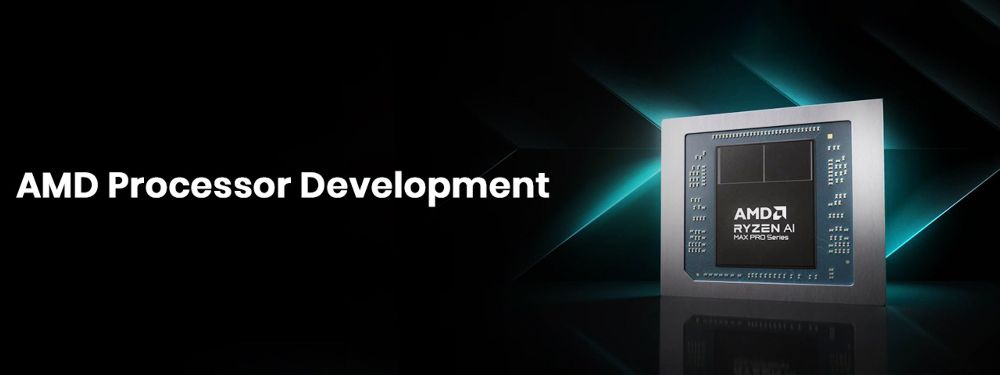
While Intel focused on steady single-core power, AMD took a different route — more cores, higher thread counts, and unbeatable value.
Over the years, AMD’s Ryzen lineup has evolved through revolutionary microarchitectures that closed the performance gap and, in many cases, overtook Intel.
AMD chips often deliver comparable or better performance for multitasking and parallel workloads — at nearly half the price of equivalent Intel processors.
The Evolution of AMD Microarchitectures
Most people assume i7 is “faster” than i5 and i5 is always “faster” than i3, but that’s not fully true.
1
🧩 Bulldozer Microarchitecture (2011–2016)
-
AMD’s first major shift toward parallelism — more cores and threads for multitasking.
-
Focused on handling multiple lightweight threads efficiently.
-
However, single-thread performance lagged behind Intel’s chips.
-
Built on the 32nm process; more about quantity (cores) than quality (IPC).
2
⚙️ New Zen Microarchitecture (2017 – Ryzen 1st Gen)
-
The comeback moment for AMD.
-
Based on a 14nm process, the first Ryzen CPUs brought massive performance jumps.
-
Roughly 52% improvement in Instructions Per Clock (IPC) over Bulldozer.
-
Balanced cores and clock speed, offering strong multitasking without overheating.
-
Competing directly with Intel’s 7th Gen lineup, but at lower prices.
3
⚡Zen+ Microarchitecture (2018 – Ryzen 2000 Series)
-
Still built on 14nm+, but fine-tuned and more efficient.
-
Delivered ~12–15% IPC boost and higher clock speeds.
-
Introduced Precision Boost 2 — dynamically adjusts clock speeds for better real-world performance.
-
Improved latency, better gaming response, and smoother multi-core workloads.
4
🧬 (Beyond Zen+ — The Legacy Continues)
-
Zen 2, Zen 3, and Zen 4continued this evolution with massive leaps in both single and multi-thread performance.
-
AMD now competes neck-and-neck — and often beats — Intel’s latest processors in creator and gaming workloads.
Performance & Value Comparison
|
Feature |
AMD Ryzen |
Intel Core |
|
Cores / Threads |
More cores and threads at each price tier |
Fewer cores per price tier |
|
Price-to-Performance |
Outstanding – often 7–10% slower but nearly 50% cheaper |
Expensive – 7–10% faster but double the cost |
|
Overclocking |
Unlocked by default (can squeeze extra performance) |
Locked on most consumer CPUs |
|
Multi-threaded Workloads |
Excellent – great for content creation, streaming, rendering |
Strong, but fewer threads can limit scaling |
|
Single-threaded Workloads |
Slightly behind Intel in earlier gens, now almost equal (Zen 4) |
Traditionally superior, especially older gens |
|
Thermal Efficiency (TDP) |
Balanced, runs cooler with newer Zen chips |
Tends to run hotter at higher clock speeds |
Real-World Takeaways

More Cores, Better Multitasking
AMD processors excel at parallel workloads — content creation, compiling code, streaming, and multitasking-heavy tasks.

Better Price-to-Performance
You get near-Intel performance for almost half the cost. Perfect for users who want value + power.

Overclocking Freedom
Most AMD CPUs come unlocked, letting enthusiasts extract even more power.

Balanced Thermals
While early-gen AMD CPUs ran hotter, the Zen+ and newer chips maintain strong performance with efficient cooling.

Evolving Fast
Each generation delivers architectural refinements — better efficiency, IPC gains, and improved gaming responsiveness.
If your focus is on multitasking, creative workloads, or long-term value, AMD’s Ryzen series is an incredible choice.
Intel might lead in raw single-core speeds, but AMD wins in efficiency, flexibility, and cost-effectiveness — a smart pick for both gamers and professionals.